The Economy of Trust: Why the Loudest Companies Are No Longer the Winners
A system built for attention is starting to break
Not so long ago, the logic of business felt relatively straightforward. A company would attract attention, convert it into interest, and eventually turn that interest into a transaction. Advertising acted as the primary engine of that sequence, and success often depended on how efficiently it could be scaled.
That model has not disappeared. But it has clearly stopped being sufficient.
Advertising is still everywhere, and investment in it continues to grow. Yet its effectiveness has become increasingly uneven. People are exposed to more content than ever before, but they engage with less of it. The result is not scarcity of attention, but something more subtle: selective resistance. Audiences filter aggressively, often without consciously noticing that they are doing so.
Within this environment, the customer journey has become fragmented to the point where it is difficult to describe as a journey at all. It no longer resembles a funnel in any meaningful sense. Instead, it behaves more like a labyrinth — non-linear, inconsistent, and shaped by a wide range of disconnected interactions that are difficult to trace or control.
The Broken Customer Journey Labyrinth is not just a metaphor. It reflects a structural change in how decisions are formed. Companies still attempt to map and optimise these journeys, but the reality increasingly resists linear interpretation.
Predictability is becoming more valuable than visibility
What emerges instead is a slower and less visible mechanism: trust.
Trust does not operate like attention. It cannot be captured through a single interaction, nor can it be reliably manufactured through isolated campaigns. It accumulates gradually, through repeated experiences that either reinforce or weaken a sense of consistency.
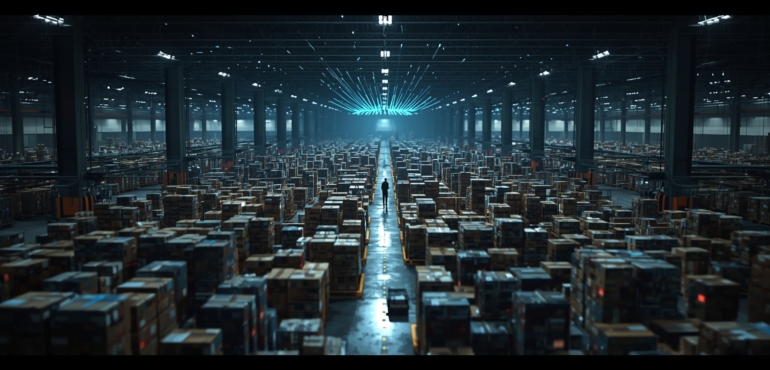
Large-scale platforms illustrate this shift particularly clearly. Consider global e-commerce systems such as Amazon. Their long-term strength has rarely depended on dramatic marketing moments. Instead, it has been built around predictability at scale.
Customers return not because each interaction is exceptional, but because it is consistent. Delivery follows expected timelines. Product descriptions align with reality. Issues, when they arise, are resolved within a known framework. Over time, this predictability becomes more valuable than any individual message or promotion.
The hidden layer beneath decision-making
This is where the nature of competition begins to shift.
Companies are no longer competing primarily for attention. In most markets, attention is already present, but saturated. The more relevant question has become whether attention translates into belief — whether a company is trusted enough for a decision to happen without prolonged hesitation.
This shift is not always visible in standard performance metrics. Funnels still exist, and conversion rates are still measured. But beneath these indicators, a different layer is increasingly decisive. It is harder to quantify, but it has a direct impact on outcomes: accumulated perception.
Trust expresses itself in subtle ways. It shortens decision time. It reduces friction. It determines whether a customer returns without reconsideration or re-enters a state of evaluation each time.
Importantly, trust is rarely built through singular, high-impact actions. It emerges from repetition — stable quality, consistent service, clear communication, and the ability to handle mistakes without disrupting continuity. Conversely, it is rarely destroyed in a single moment. More often, it erodes gradually through small inconsistencies that accumulate until perception shifts.
Trust as the new economic capital
In saturated markets, this becomes increasingly significant. When the number of available choices exceeds the capacity for meaningful comparison, decision-making shifts away from rational evaluation and towards perceived reliability. That perception is formed less by messaging and more by lived experience over time.
As a result, competition is changing in character. It is no longer defined solely by price or product differentiation, and less even by the scale of advertising spend. It is increasingly defined by the speed at which trust is established — or lost.
Trust, in this sense, functions as a form of economic capital. It compounds over time, reduces transaction friction, and lowers the cost of every subsequent interaction. Unlike financial capital, however, it cannot be deployed once and preserved. It requires continuous reinforcement through behaviour rather than communication alone.
Marketing gradually stops being a separate function and becomes inseparable from operations. What a company does consistently becomes indistinguishable from what it communicates externally.
A quieter economy with louder consequences
The Broken Customer Journey Labyrinth is not a problem to be solved through better mapping or more precise targeting. It is a condition of the modern market itself. And within that condition, the companies that endure are not necessarily those that capture the most attention, but those that accumulate trust most reliably over time.
The economy of attention remains visible. The economy of trust, by contrast, operates more quietly. But it is increasingly the system that determines which businesses remain stable — and which gradually lose relevance.